 Lavkush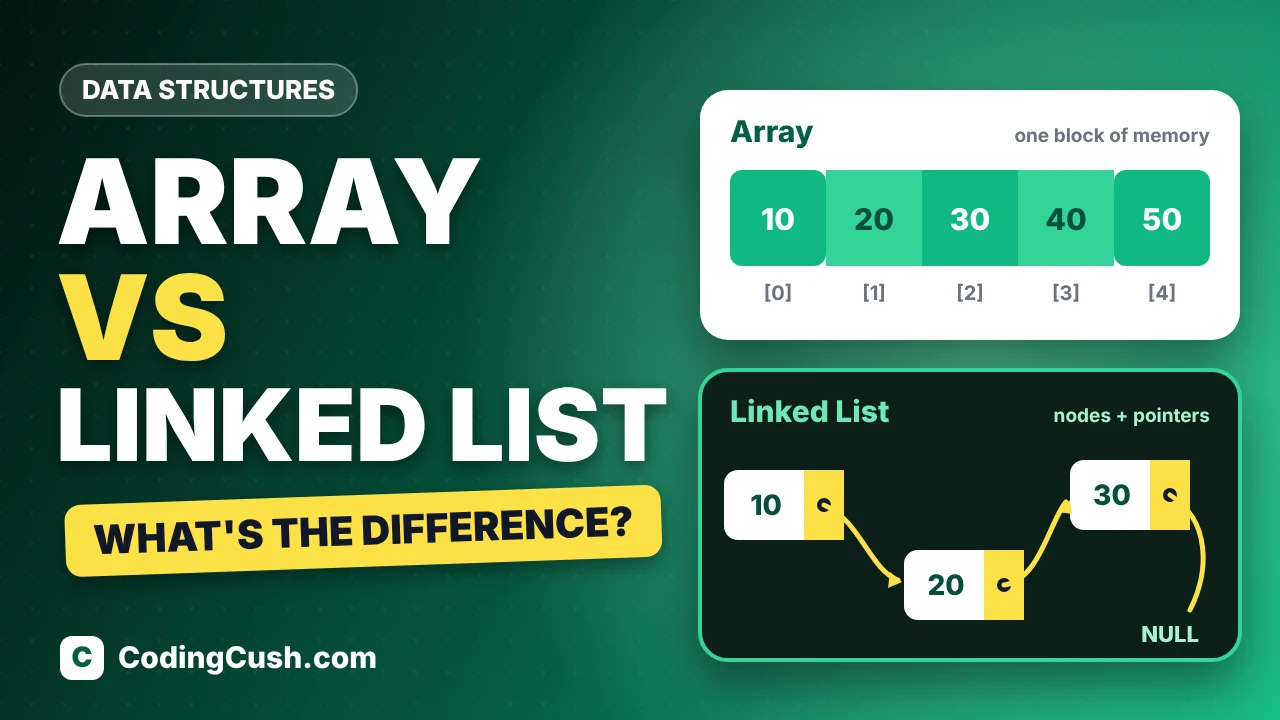
An array and a linked list both store a collection of items in order, but they organise memory in opposite ways. An array keeps all its items together in one continuous block, so it can jump straight to any position. A linked list scatters its items as separate nodes across memory, where each node holds one value plus a pointer to the next node, so it must walk from the start to reach a position — but it can insert and remove items without shifting anything. This guide explains both structures with simple pictures in words, compares their speed operation by operation, and tells you when to use each one.
What Is an Array?
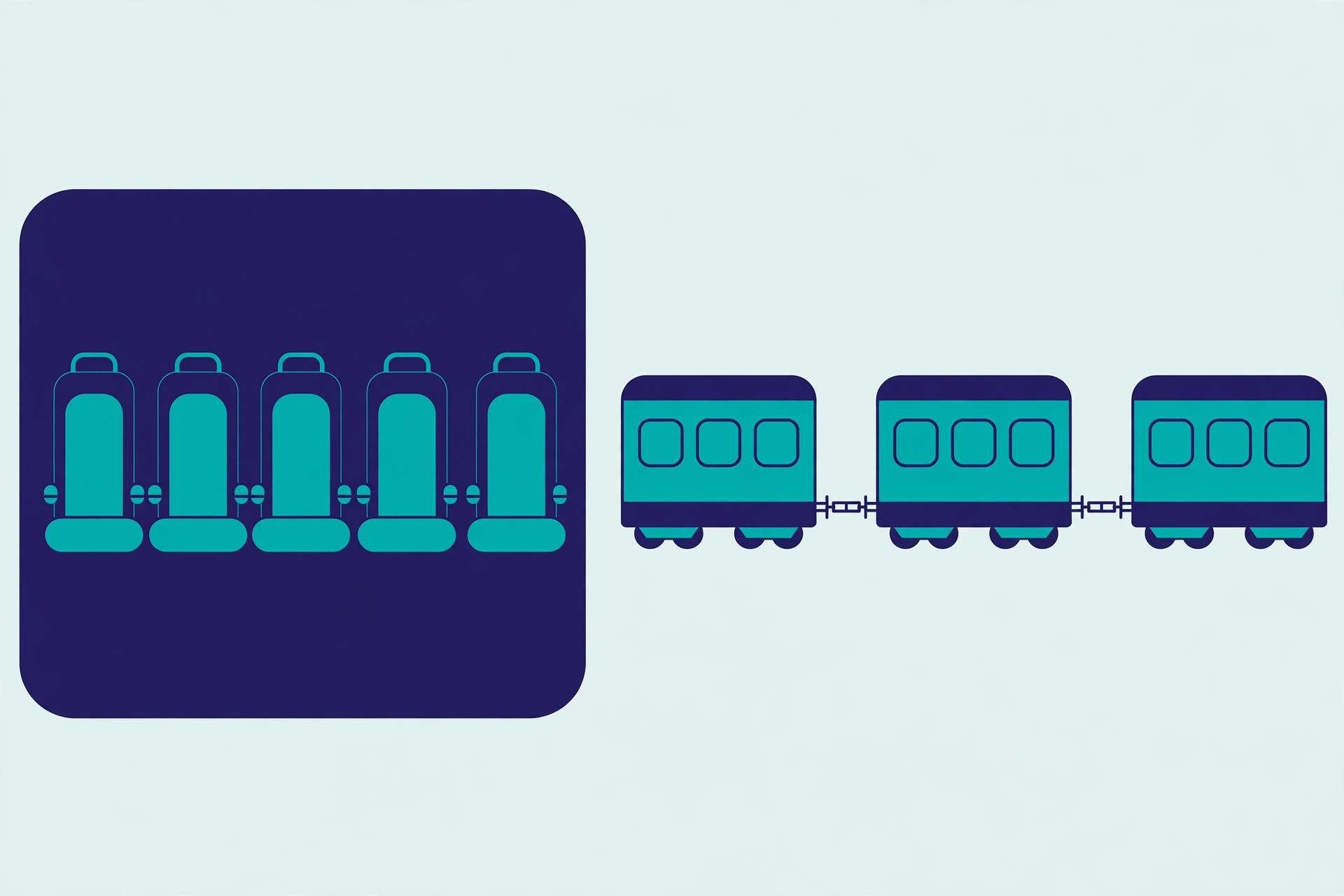
Think of an array as a row of numbered seats in a cinema, all side by side. Seat 0, seat 1, seat 2 — each seat holds one item, and because the seats are together in one block, the computer can calculate exactly where seat number 500 is and go there in one step. That instant jump is called random access, and it is the array's biggest strength.
marks = [72, 85, 90, 66]

print(marks[0])   # 72
print(marks[2])   # 90  — reached instantly by index
You already use arrays in every language: Python lists, JavaScript arrays and Java arrays are all built on this idea. MDN's reference for the JavaScript Array object on MDN shows how rich the everyday array toolkit is, from push and pop to map and filter. The weakness of the cinema-row design appears when you insert: to put a new seat in the middle, every seat after it must physically shift along — and removing an item means shifting everything back to close the gap.
What Is a Linked List?
A linked list is like a treasure hunt. Each clue card tells you one value and where the next card is hidden. The cards can be anywhere — different rooms, different streets — because they are connected by directions, not by standing side by side. In programming terms, each item is a node containing the data and a next pointer. The list keeps one pointer called the head to the first node, and the last node's pointer is empty (null), which marks the end.
class Node:
    def __init__(self, data):
        self.data = data
        self.next = None   # pointer to the next node

# Build a list: 72 -> 85 -> 90
head = Node(72)
head.next = Node(85)
head.next.next = Node(90)

# Walk the list from the head
current = head
while current is not None:
    print(current.data)
    current = current.next
# Output: 72, 85, 90
Notice how reading the third value required starting at the head and following two pointers. There is no index and no shortcut — reaching item number 500 means 500 small hops. But look at what insertion costs: to place a new node between 72 and 85, you change just two pointers. Nothing else moves, no matter how long the list is.
Speed Compared, Operation by Operation
Because the two structures organise memory differently, each one wins at different jobs. Here is the honest comparison — this table is also the answer interviewers want when they ask this exact question:
| Operation | Array | Linked List |
|---|---|---|
| Access item by position | O(1) — instant, using the index | O(n) — walk from the head, node by node |
| Search for a value | O(n) — may check every item | O(n) — may check every node |
| Insert at the beginning | O(n) — shift everything right | O(1) — just point the head at the new node |
| Insert in the middle | O(n) — shift the second half | O(1) once you are at the spot (reaching it is O(n)) |
| Delete an item | O(n) — shift everything left to close the gap | O(1) once you are at the spot — re-point around the node |
| Memory use | Only the items; needs one big free block | Items plus one pointer per node; blocks can be anywhere |
| Fixed or flexible size? | Classic arrays are fixed-size at creation | Grows and shrinks node by node, naturally |
Two honest notes on this table. First, "insert in the middle" for a linked list is only O(1) after you have walked to that middle spot, and the walk itself costs time — linked lists shine most at the beginning of the list, or when you are already standing at the right node. Second, modern languages hide much of this: a Python list or JavaScript array quietly grows by over-allocating space, so appending at the end is fast in practice. Python's own documentation describes these behaviours in its data structures tutorial on docs.python.org, including the costs of inserting at the front of a list.
When Should You Use Each One?
Choose an array when you mostly read data by position, when the size is known or changes rarely, and when you want the simplest, fastest everyday tool. That covers the large majority of beginner and real-world code: marks of students, products in a cart, days of the week. If you have worked through our comparison of Python list vs tuple, you have already been making this kind of storage decision inside the array family.
Choose a linked list when insertions and deletions happen constantly, especially at the front, and you rarely need to jump to a position in the middle. Real examples include an undo history, a playlist where songs are added and removed while playing, the chain of pages in a browser's back button, and the building blocks under other structures like stacks, queues and hash tables. Simpler array-based tools, like the ones in our JavaScript array methods guide, are still the right default until you can name the specific reason a linked list would help.
There is also a middle family worth knowing about: the doubly linked list, where each node points both forward and backward, so you can walk in either direction, and the circular linked list, where the last node points back to the head, forming a ring. They trade a little extra memory per node for more flexible movement, and they appear in music players that loop playlists and in turn-based games that cycle through players.
Frequently Asked Questions
Which is faster, an array or a linked list?
Neither is simply "faster" — it depends on the operation. Arrays are faster for reaching an item by index (O(1) against O(n)). Linked lists are faster for inserting or deleting at the front, because no items need to shift. Searching an unsorted collection costs O(n) in both.
Why can't a linked list jump to an index like an array?
Because its nodes are scattered in memory and connected only by pointers. The only way to reach the fifth node is to follow the chain from the head: first, second, third, fourth, fifth. An array can jump because its items sit in one continuous block, so positions can be calculated.
Which one uses more memory?
A linked list uses extra memory — one pointer stored inside every node. An array stores only the items, but it needs one continuous free block large enough for all of them, which a linked list does not.
Do real programming languages use linked lists?
Yes, but usually behind the scenes. Java has a built-in LinkedList class, C programmers build them by hand, and operating systems and other data structures use them internally. Everyday application code, however, uses arrays and dynamic lists far more often.
Conclusion
Array vs linked list is really one trade-off, seen from two sides. Put the items together in one block and you get instant access by index but slow changes in the middle — that is an array. Scatter the items and connect them with pointers and you get effortless insertions and deletions but slow, step-by-step access — that is a linked list. Learn to ask "will I mostly read by position, or mostly insert and delete?" and you will pick the right structure every time. That single question is the heart of data structures, and you have just understood it.
Leave a Comment