

Stack vs Queue: What Is the Difference? (With Examples)
Stack vs queue explained simply: LIFO vs FIFO, push and pop vs enqueue and dequeue, with plates, coffee queues and Python examples for interviews.
Data structures and algorithms explained in simple English — arrays, linked lists, stacks, queues, trees and sorting, with code examples.
Stack vs queue explained simply: LIFO vs FIFO, push and pop vs enqueue and dequeue, with plates, coffee queues and Python examples for interviews.
Binary search returning -1 again? The five small mistakes that break it — unsorted data, wrong mid, bad loops — with corrected Python and JavaScript code.
Big O notation explained in simple words: learn to read the speed of any code step by step, with a plain-English chart, real examples and common mistakes.
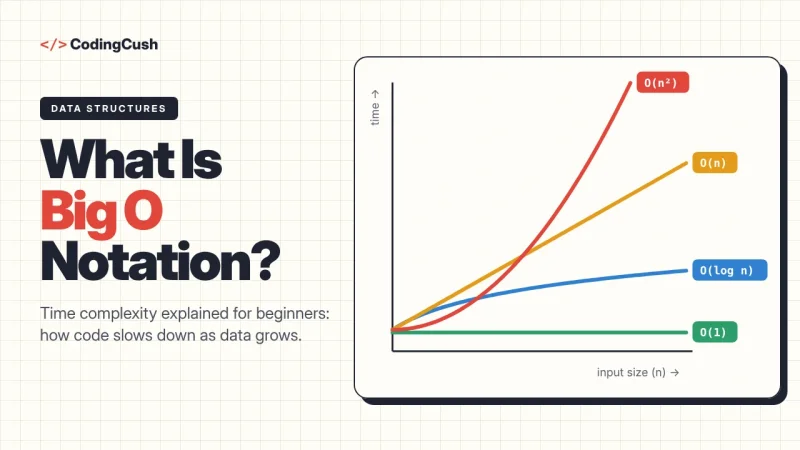
Big O notation describes how code slows down as data grows. Learn O(1), O(n), O(n²) and O(log n) with tiny code examples and simple real-life comparisons.
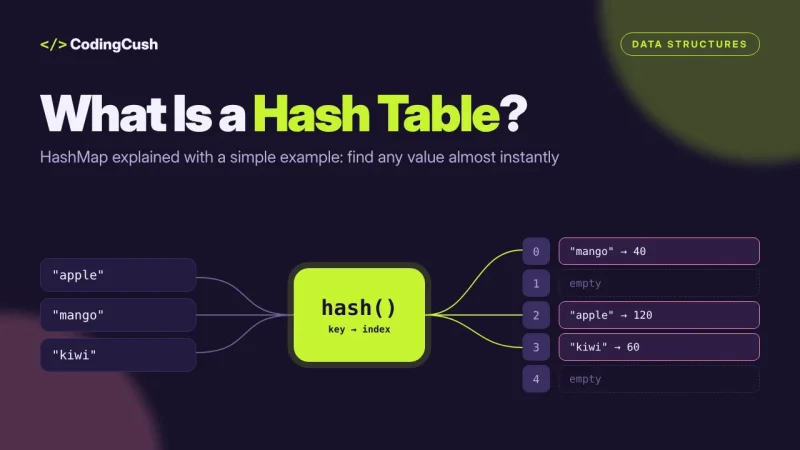
A hash table stores data as key-value pairs and finds any value almost instantly. Learn how hashing works, what a collision is, and when to use a HashMap.
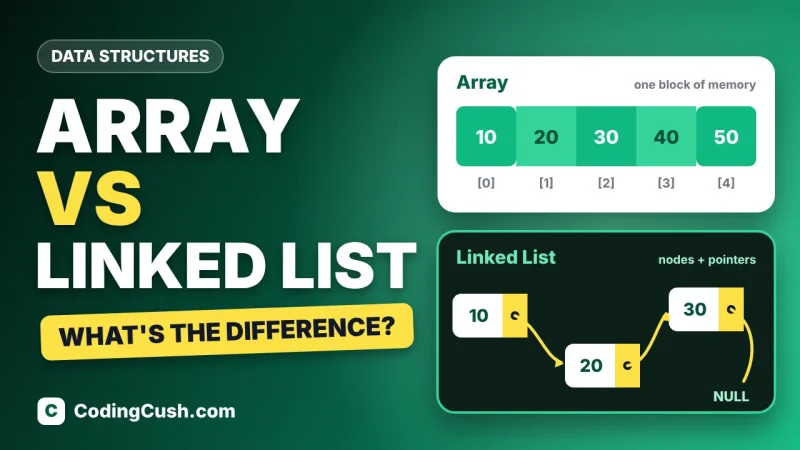
Arrays store items together in one block, linked lists scatter nodes connected by pointers. Compare access, insert and delete speed, memory and use cases.
Try a different word, or clear the filter to see everything on this page.


Join 620+ developers learning the simple way. One useful email when new tutorials land — no spam, ever.
You're on the list — the next tutorial will land straight in your inbox.
 Lavkush