

 Lavkush
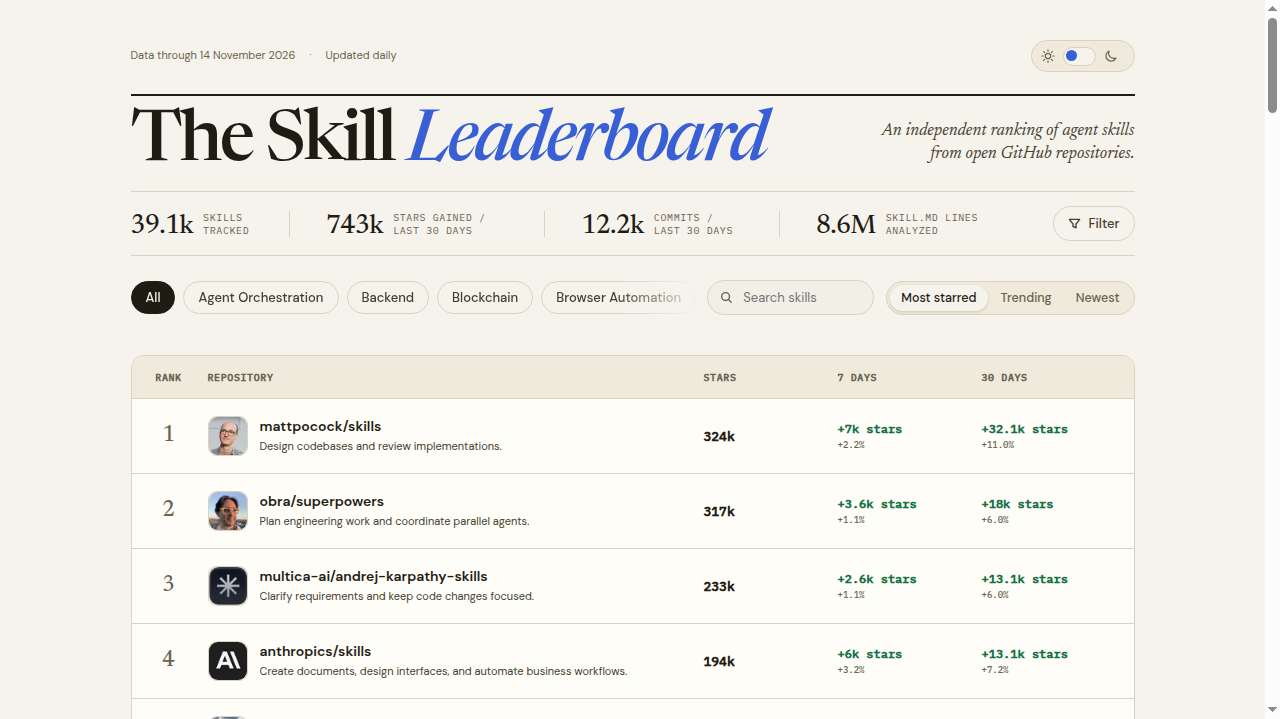
Claude Skills are small instruction packs that teach an AI coding agent a new trick, and in September 2026 developers starred them at a wild pace. The fastest-growing skill repo of the month, Ponytail, gained 30,432 GitHub stars in 30 days. This article ranks the top 10 fastest-growing Claude skill repos of September 2026 by stars gained, using the data tracked by Skill Leaderboard, and explains what each skill actually does in plain words.
What Is a Claude Skill, in 30 Seconds?
A skill is a folder with a SKILL.md file inside it. That file holds instructions, examples and sometimes small scripts. When you give a skill to a coding agent, the agent reads those instructions and follows them whenever the matching task shows up. Think of it as a reusable recipe card: instead of explaining the same preference to your AI every day, you write it once and the agent remembers.
Skills are the layer above the model itself. If you are new to the agent side, first read our explainer on what Claude AI is and what it can do. Anthropic also keeps its own public collection in the anthropics/skills repository, which is a good place to see the format up close.
The Top 10, Ranked by Stars Gained in September 2026
Every figure below is the number of GitHub stars the repo gained between 1 and 30 September 2026, as reported by Skill Leaderboard. The total stars column shows roughly where each repo stands now, in mid November 2026, so you can see which ones kept growing after September ended.
| # | Skill | Repo | Stars gained (Sept 2026) | Total stars (approx.) |
|---|---|---|---|---|
| 1 | Ponytail | DietrichGebert/ponytail | +30,432 | 191k |
| 2 | Matt Pocock Skills | mattpocock/skills | +29,787 | 324k |
| 3 | I Have ADHD | ayghri/i-have-adhd | +26,258 | 61k |
| 4 | Security Audit Skill | cloudflare/security-audit-skill | +20,148 | 72k |
| 5 | Superpowers | obra/superpowers | +13,841 | 317k |
| 6 | Diagram Design | cathrynlavery/diagram-design | +13,795 | 67k |
| 7 | Humanizer | blader/humanizer | +13,769 | 69k |
| 8 | Graphify | Graphify-Labs/graphify | +9,651 | 147k |
| 9 | Addy Osmani Skills | addyosmani/agent-skills | +8,880 | 117k |
| 10 | Impeccable | pbakaus/impeccable | +8,505 | 110k |
1. Ponytail (DietrichGebert/ponytail): +30,432 stars
Ponytail finished September at number one, and its idea is funny because it is true: the repo says it makes your AI agent think like the laziest senior developer in the room, because the best code is the code you never wrote. The skill pushes the agent to reuse what already exists, keep solutions small, and audit repo quality instead of adding more and more code. Developers clearly loved the honesty. It also tracks technical debt, so the laziness stays smart, not sloppy.
2. Matt Pocock Skills (mattpocock/skills): +29,787 stars
Matt Pocock's skills repo is exactly what its description promises: skills for real engineers, taken straight from the author's own agent setup. The focus is designing codebases well and reviewing implementations properly, the daily work of a senior developer. Pocock is a well-known TypeScript educator, so thousands of developers trust his taste. The repo is now the biggest on the whole leaderboard, at roughly 324k stars.
3. I Have ADHD (ayghri/i-have-adhd): +26,258 stars
I Have ADHD is the surprise hit of the list. The skill makes agent responses concise, structured and action-first, so answers are easy to scan and easy to act on, with the important step never buried in the middle. You do not need ADHD to benefit; anyone who has scrolled through a wall of AI text looking for the one useful line will understand why this repo exploded.
4. Security Audit Skill (cloudflare/security-audit-skill): +20,148 stars
Cloudflare's Security Audit Skill audits codebases and APIs for vulnerabilities. Two things made it grow fast: security is the one area where nobody wants to guess, and the author is Cloudflare, a company the whole internet already trusts with security. An official skill from a big name carries weight that a random repo cannot match.
5. Superpowers (obra/superpowers): +13,841 stars
Superpowers describes itself as an agentic skills framework and software development methodology that works. Instead of one small trick, it teaches the agent how to plan engineering work and coordinate parallel agents on bigger tasks. At roughly 317k total stars, it is one of the giants of this list.
6. Diagram Design (cathrynlavery/diagram-design): +13,795 stars
Diagram Design draws branded diagrams in HTML and SVG. Every developer has suffered through ugly architecture diagrams made in a hurry; this skill produces clean, good-looking ones from your agent instead. It is a narrow skill, but it solves a pain everyone recognises.
7. Humanizer (blader/humanizer): +13,769 stars
Humanizer edits AI-written text and removes the signs of AI-generated writing, turning stiff output into natural prose. Writers, students and content teams all feel this problem daily, so a skill that polishes text in one step was always going to travel fast. Its growth also says something honest about 2026: we all use AI to write, and we all want the result to sound human.
8. Graphify (Graphify-Labs/graphify): +9,651 stars
Graphify turns a whole codebase, together with its docs, SQL schemas, configs and PDFs, into a queryable knowledge graph. On a big project, the hardest question is usually where things live and how they connect, and a map the agent can query is a serious upgrade.
9. Addy Osmani Skills (addyosmani/agent-skills): +8,880 stars
Addy Osmani's agent skills teach a disciplined loop: specify, build, verify and ship software incrementally. Osmani is a long-time Chrome engineer whose books and talks shaped a generation of web developers, so his personal workflow, packaged as skills, was always going to attract attention. This is the slow and steady entry on the list, and probably one of the most useful.
10. Impeccable (pbakaus/impeccable): +8,505 stars
Impeccable audits UX and refines frontend design, which makes it the designer's answer to the security audit skill. It comes from Paul Bakaus, another respected name in web tooling. Agents can write frontend code quickly, but taste is rarer; a skill that reviews the result like a design critic fills a real gap.
What This List Tells Us
Three patterns stand out. First, the top of the list is about discipline, not magic: write less code (Ponytail), answer clearly (I Have ADHD), work like a senior engineer (Pocock, Osmani). Second, famous names matter: Pocock, Osmani, Bakaus and Cloudflare all brought an audience with them. Third, review skills are hot: security audits, UX audits and code review all appear, because generating code is now easy and checking it is the bottleneck. If you are new to GitHub itself, our guide on what GitHub is and why it matters explains stars, repos and forks in simple words.
How to Try a Skill Safely (and Mistakes to Avoid)
Start with one skill, not ten. Read its SKILL.md file first; it is plain text, and you should understand what the agent will do before you install anything. Add the skill, run it on a small test project, and watch whether the output actually improves. Only then keep it in your daily setup. If you already use an AI pair programmer, our walkthrough on using GitHub Copilot in VS Code shows the same careful, one-step-at-a-time approach.
The common mistakes are easy to guess. Installing every trending skill at once, so they fight each other. Skipping the SKILL.md and trusting the repo name alone. And treating stars as a quality guarantee: stars measure attention, not testing. A small repo you have read fully is safer than a famous one you have not.
Frequently Asked Questions
Which Claude skill repo grew the fastest in September 2026?
Ponytail (DietrichGebert/ponytail), with 30,432 GitHub stars gained between 1 and 30 September 2026, as tracked by Skill Leaderboard. Matt Pocock Skills was a close second with 29,787.
What is a Claude Skill?
A skill is a reusable pack of instructions, usually centred on a SKILL.md file, that teaches an AI agent how to handle a type of task in a specific way. You install it once, and the agent follows it whenever the task matches.
Are these skill repos free?
The repos on this list are public on GitHub, so you can read and download them freely. Each repo has its own licence, so check that file if you plan to use a skill in commercial work.
Do these skills only work with Claude?
Not always. The SKILL.md format is open, and Skill Leaderboard tracks agent skills generally, so many of these repos also work with other coding agents. Check the README of the repo you like for the agents it supports.
Conclusion
September 2026 was the month Claude Skills went mainstream: a joke-named repo about writing less code beat everyone, a formatting skill for clearer answers took third place, and Cloudflare showed that big companies now publish skills too. Pick one repo from this list, read it properly, and try it on a small project this week. That is how the star counts on next month's leaderboard get decided.




Leave a Comment