

 Anand Bajrangi
Affiliate marketing means recommending products with your special tracking link and earning a commission when someone buys through it. Beginners usually start with Amazon Associates, which is free to join and pays roughly 1 to 9 percent commission depending on the product category. You do not need your own product, stock or delivery system. You need an audience that trusts your recommendations, even a small one. This guide shows the exact path to a first commission, expanding the affiliate section of our pillar guide on 10 ways to earn money online.
How Affiliate Marketing Works, in One Example
Imagine you review a budget microphone on your blog or channel and add your affiliate link to its product page. A reader clicks your link, buys the microphone within the tracking window, and Amazon pays you a percentage of the sale price. The buyer pays nothing extra. The commission comes out of the platform's pocket, as a thank you for sending the customer. Multiply that one honest review by twenty useful reviews, and you can see how a small content library quietly becomes a monthly income.
Step 1: Join a Beginner Friendly Program
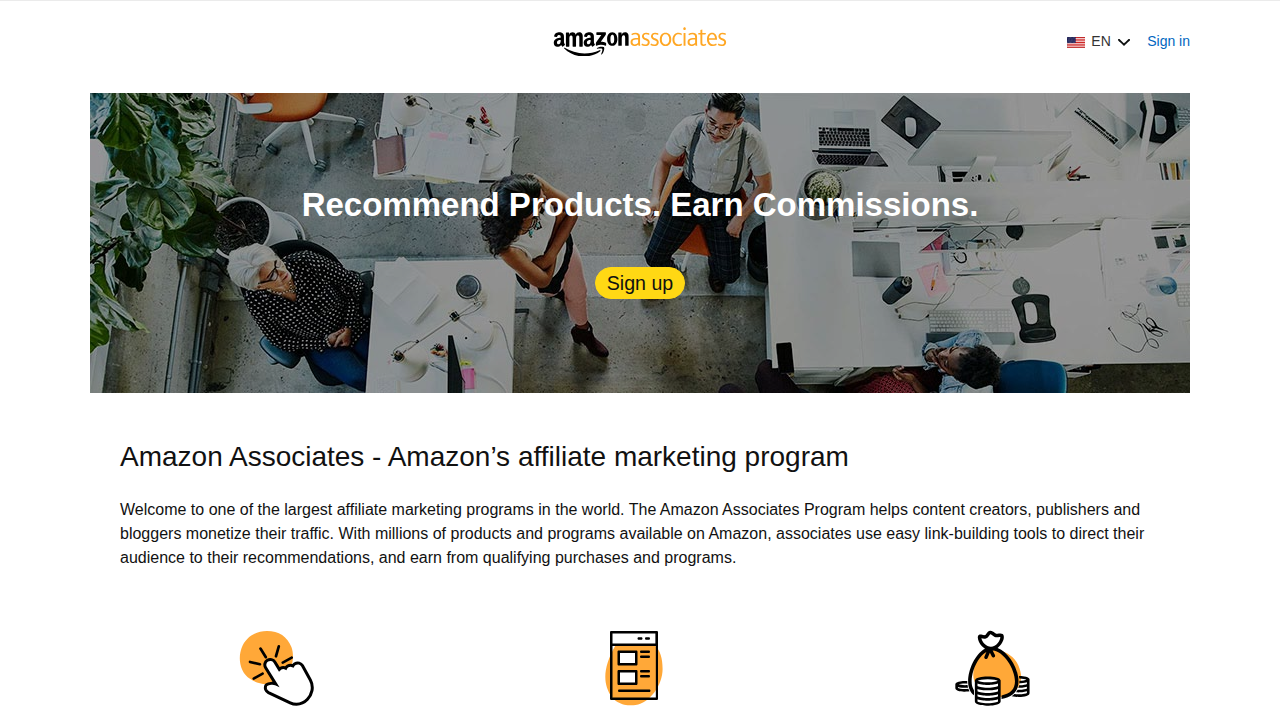
Start where approval is easy and products are familiar. The Amazon Associates program is the common first step: joining is free, almost every product gets a link, and people already trust buying there. One rule matters from day one: Amazon requires your first three qualifying sales within 180 days of joining, or the account closes and you apply again. So join when you are ready to publish your first reviews, not months before.
Later, you can add programs that pay better in your topic, like hosting companies for a tech blog or course platforms for an education channel. But one program, learned properly, beats five programs joined in excitement and abandoned in confusion.
Step 2: Choose Products Your Audience Actually Needs
Commissions follow usefulness, not price tags. Beginners often promote costly gadgets because the commission per sale looks big, then wonder why nobody buys. A 999 rupee product your audience genuinely needs will outsell a 40,000 rupee product they are only dreaming about. Promote things you use yourself or have honestly tested: the books on your desk, the tool you work with daily, the budget gear you really bought. First hand experience gives your review details that a copied specification list never has, and readers can feel the difference in two paragraphs.
Step 3: Create Content That Helps People Decide
Three content formats earn most beginner commissions. Honest reviews answer "is this worth my money". Comparisons answer "which of these two should I buy". Tutorials answer "how do I do this", with the product as a natural part of the solution. All three work on a blog, a YouTube channel or even a focused Instagram page. What does not work is pasting product photos with a link and the word "best". Google and readers both ignore it, correctly.
Traffic is the fuel here. If your content exists but nobody finds it, our checklist for websites that get no traffic will show you which problem to fix first, whether the audience is on your blog, YouTube or Instagram.
Step 4: Disclose Your Links, Every Time
This step is not optional decoration. The law in many countries and every serious program's rules require you to tell your audience that your link earns you a commission. One clear line near the top of the content is enough: "This post contains affiliate links, so I may earn a small commission at no extra cost to you." In India, the Advertising Standards Council of India publishes clear rules on exactly this in its influencer advertising do's and don'ts, which ask creators to label paid promotions openly with tags like #Ad or #Sponsored. Disclosure does not reduce sales. Readers respect it, and hiding it risks your account, which is your whole business.
Step 5: Track, Learn and Improve
Your program dashboard shows which links get clicks and which clicks become sales. Check it weekly. A review with many clicks and no sales usually means the price rose or the product disappointed buyers, so update your recommendation honestly. A tutorial with steady sales deserves a follow up piece. This boring loop of publish, measure and improve is the entire difference between accounts that earn pocket money once and accounts that earn every month.
How Much Can a Beginner Earn?
| Stage | Typical effort | Realistic monthly income |
|---|---|---|
| First 3 months | 5 to 10 reviews or tutorials live | 0 to 1,500 rupees |
| Months 4 to 9 | 20 to 40 pieces of content, growing traffic | 2,000 to 10,000 rupees |
| After a year | A focused content library plus email or community | 10,000 to 50,000 rupees, topic dependent |
Affiliate income is uneven by nature. Festival sales months spike, quiet months dip. That is normal, and it is why experienced affiliates build on more than one program over time. One more honest note on expectations: your first commission will probably be embarrassingly small, maybe 40 or 60 rupees on a small product. Celebrate it anyway. That tiny payment is proof the whole machine works: content, click, purchase, commission. From there, income is a multiplication problem, not a mystery. More helpful content, better matched products and a growing audience multiply a proven system, and systems scale far more calmly than luck does.
Mistakes That Kill Beginner Commissions
The most common mistake is promoting products you have never touched. Readers ask surprisingly specific questions in comments, and one honest "I have not used it" is fine, but a review built entirely from the product page fools nobody and converts nobody. If you cannot buy the product yet, say clearly that your comparison is based on specifications and owner reviews, and update it when you do own it. The second mistake is joining a program and pasting links everywhere without content around them. A link inside a genuinely helpful tutorial earns for months. A link dropped into random comment sections earns a ban.
The third mistake is giving up at the ninety day mark. Affiliate content behaves like a plant, not a vending machine. A review published today may take two or three months to rank on Google and start selling weekly. Most accounts that eventually earn well have a quiet first quarter that looks, from the inside, exactly like failure. The accounts are identical at that point. The only difference is that one creator kept publishing. Track your clicks monthly, improve your best two or three pages each month, and let the library grow. Commissions follow libraries, not lucky posts.
Frequently Asked Questions
Is affiliate marketing legal and safe in India?
Yes. Affiliate marketing is a normal, legal way to earn. You must disclose your affiliate links, promote products honestly, and pay tax on your earnings like any other income.
Do I need a website to start affiliate marketing?
No. Many beginners start on YouTube or Instagram where they already have an audience. A website helps a lot over time because search traffic keeps buying while you sleep, but it is not compulsory on day one.
How much money do I need to start?
Zero rupees to join programs like Amazon Associates. Your real investment is time spent creating honest, useful content that people can find.
Why did my link get clicks but no sales?
Common causes are a price increase on the product, readers researching now and buying much later, or content that attracts curious readers instead of buyers. Review and comparison content usually converts better than general entertainment content.
Conclusion
Affiliate marketing is a trust business disguised as a links business. Recommend fewer products, know them properly, disclose your links proudly, and publish decision helping content every week. Do that for six months and your first commission stops being a hope and becomes a habit.



Leave a Comment