Introduction
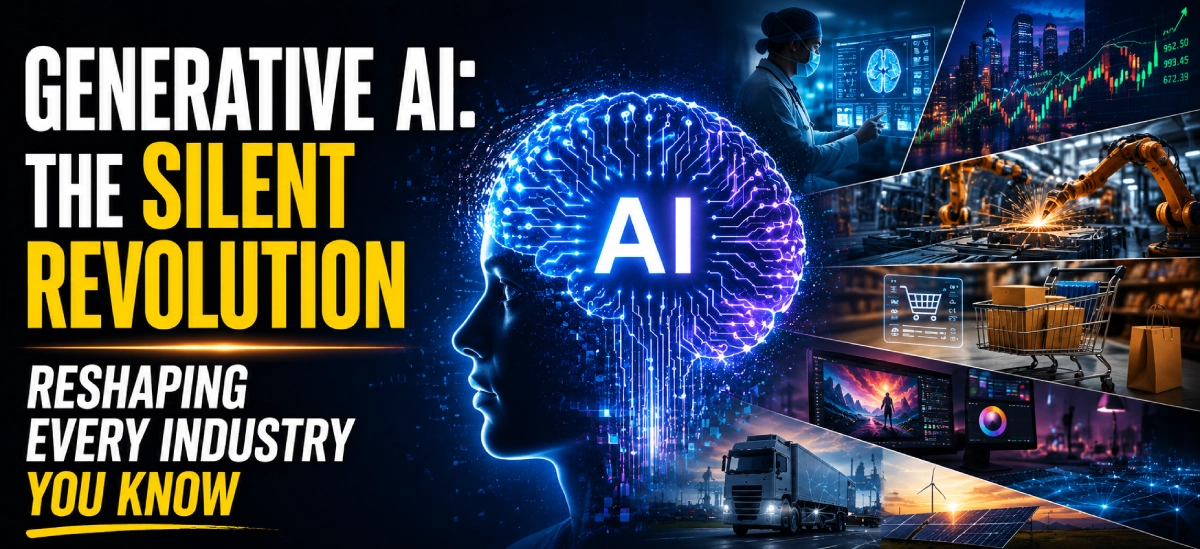
You may not notice it — but Generative AI is already all around you.
It writes product descriptions on shopping websites. It answers your customer service chats. It helps doctors read medical scans faster. It composes music, generates code, and designs marketing campaigns.
This is not a technology of the future. It is happening right now, quietly, in almost every industry you can think of.
So what exactly is Generative AI? And why does it matter to you? Let's break it down in plain, simple English.
What Is Generative AI?
Generative AI is a type of artificial intelligence that can create new content — text, images, audio, video, and even computer code — based on patterns it has learned from large amounts of data.
Unlike older AI systems that could only follow fixed rules, Generative AI can think creatively (in a sense). It can write a poem, design a logo, summarize a legal document, or suggest a medical diagnosis — all on its own.
Popular examples include:
-
ChatGPT – generates human-like text conversations
-
DALL·E / Midjourney – creates images from text descriptions
-
GitHub Copilot – writes and completes computer code
-
Sora – generates realistic videos from text prompts
Why Is It Called a "Silent" Revolution?
Unlike the launch of the internet or the smartphone - both of which were very visible and public - Generative AI is sneaking into our lives through the back door.
It's running inside the apps you already use. It's optimizing supply chains you never see. It's reading insurance claims before a human ever does. Most people don't even realize AI made a decision that affected them.
That's what makes it a silent revolution. It is reshaping the world without making much noise - until you stop and look.
How Generative AI Is Reshaping Every Industry
1. 🏥 Healthcare
Generative AI is helping doctors work smarter and faster.
-
It can analyze thousands of medical images (X-rays, MRIs) in seconds and flag potential problems
-
It helps researchers design new drugs by predicting how molecules will behave
-
It drafts patient summaries and reports, saving doctors hours of paperwork
-
AI chatbots provide 24/7 mental health support to patients who can't access a therapist immediately
Real example: Google's Med-PaLM 2 scored above 85% on US medical licensing exam questions - matching the performance of expert doctors.
2. 💰 Finance & Banking
The financial sector has embraced Generative AI rapidly.
-
Banks use it to detect fraud in real time by analyzing unusual patterns in transactions
-
AI generates personalized financial reports for clients automatically
-
It helps compliance teams review thousands of legal documents quickly
-
Trading firms use AI models to predict market movements and automate decisions
Real example: JPMorgan Chase uses an AI tool called COiN that reviews legal documents in seconds — a task that used to take lawyers 360,000 hours per year.
3. 🎓 Education
Education is being transformed from the inside out.
-
AI tools create personalized learning plans for each student based on their progress
-
Teachers use AI to generate quizzes, lesson plans, and study guides in minutes
-
Students get instant feedback on essays and assignments
-
Language learning apps like Duolingo use AI to simulate real conversations
Challenge: Schools are also wrestling with how to handle AI-written homework — a debate that is still evolving.
4. 🛍️ Retail & E-Commerce
Generative AI has become the invisible sales assistant behind every major shopping platform.
-
It writes thousands of product descriptions automatically
-
AI powers personalized product recommendations ("You might also like...")
-
Virtual try-on tools use AI to show customers how clothes or makeup will look on them
-
Chatbots handle customer service questions around the clock
Real example: Amazon uses Generative AI to summarize thousands of customer reviews into a short, helpful paragraph — so you don't have to read 500 reviews yourself.
5. 🎨 Media, Marketing & Creative Industries
This is where Generative AI has made the biggest — and most controversial — splash.
-
Marketers use AI to write ad copy, social media posts, and email campaigns
-
Designers generate logos, banners, and visuals in seconds
-
AI tools help video editors cut footage, add subtitles, and create animations
-
Music producers use AI to compose background scores and sound effects
Hot debate: Who owns AI-generated art? Is it the user, the company, or no one? Copyright law is still catching up.
6. ⚖️ Legal Industry
Law firms — traditionally slow to change — are now adopting AI fast.
-
AI reads and summarizes lengthy contracts in seconds
-
It helps lawyers research case law and find relevant precedents quickly
-
AI drafts standard legal documents like NDAs, lease agreements, and terms of service
-
It assists in due diligence during mergers and acquisitions
7. 🏗️ Manufacturing & Supply Chain
Even factory floors are feeling the AI revolution.
-
AI predicts when machines will break down — enabling preventive maintenance
-
It optimizes production schedules to reduce waste and delays
-
Generative design tools help engineers create stronger, lighter parts by testing thousands of design options automatically
-
AI manages inventory and logistics to reduce costs
8. 🌍 Climate & Sustainability
One of the most exciting applications is in fighting climate change.
-
AI models help scientists predict weather patterns and natural disasters more accurately
-
It optimizes energy grid management, reducing waste
-
AI helps design more efficient solar panels and batteries
-
Generative AI is used to model the impact of different carbon reduction strategies
The Risks We Cannot Ignore
Every revolution has a shadow side. Generative AI is no different.
⚠️ Misinformation & Deepfakes
AI can generate fake images, videos, and text so convincingly that it's becoming hard to tell what's real. This is a serious threat to journalism, democracy, and public trust.
⚠️ Job Displacement
Some roles — especially in content writing, data entry, customer service, and basic coding — are already being automated. The key question is: will new jobs replace the lost ones fast enough?
⚠️ Bias & Fairness
AI models learn from human-created data — which means they also learn human biases. If not carefully monitored, AI can make unfair decisions in hiring, lending, or healthcare.
⚠️ Privacy Concerns
Generative AI systems are trained on massive datasets that may include personal information. Who controls that data — and how it is used — is a growing legal and ethical concern.
What Does the Future Look Like?
The next few years will likely bring:
-
Multimodal AI — systems that can see, hear, speak, and act all at once
-
Agentic AI — AI that can complete complex multi-step tasks on your behalf, without constant supervision
-
AI regulation — governments around the world are drafting laws to govern how AI is built and used
-
Smaller, smarter models — AI that runs efficiently even on your smartphone or laptop
The revolution is not slowing down. If anything, it is accelerating.
What Should You Do?
Whether you are a student, a business owner, a professional, or just a curious person — here is simple advice:
-
Don't fear it - understand it. Learn the basics of how AI works.
-
Experiment with tools relevant to your field - Try them, see what they can and cannot do.
-
Think critically - AI-generated content can be wrong. Always verify important information.
-
Stay updated - This space is changing every few months. Follow reliable sources.
Conclusion
Generative AI is not a sci-fi fantasy. It is not a passing trend. It is a fundamental shift in how the world creates, communicates, and operates.
It is reshaping healthcare, finance, education, retail, law, and even climate science - often without us even noticing.
The silent revolution is already here.
The only question is: are you ready to be part of it?

0 Comments
Leave a Comment